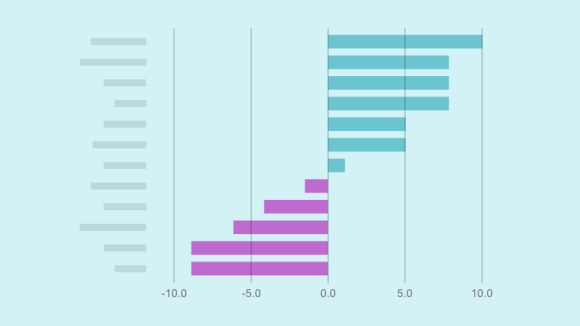
MaxDiff (short for Maximum Difference Scaling) is a survey research technique used to measure relative preferences or priorities.
Instead of asking participants to rate each item independently, MaxDiff presents small groups of items and asks participants to choose the most important (or most appealing) and the least important (or least appealing).
By forcing participants to make trade-offs, MaxDiff reveals which items stand out relative to all the others.
MaxDiff (Best-Worst Scaling) Explained
MaxDiff (Best-Worst Scaling) is a survey feature that offers you a smarter way to measure customer priorities.
If your surveys include long lists of features, benefits, or marketing messages, often traditional rating scales can be unreliable. This is because participants tend to rate everything as “important”, making it difficult to identify what truly drives customer decisions.
That’s where MaxDiff comes in.
MaxDiff (Best-Worst Scaling) Example
We’ll use a regional Travel to Work Survey involving thousands of employees across multiple organisations.
When using traditional rating questions, many workplace travel improvements such as cycle storage, EV charging, and flexible working all receive similarly high scores.
This makes it difficult to decide where to invest.
Rather than rating each option from 1 to 5, a MaxDiff question might show a small set of options (flexible working, free parking, cycling facilities etc.) and ask participants to pick the most and least important from the list.
The results produce a much clearer hierarchy, such as flexible working support and cycle storage ranking higher, and options like parking availability and shower facilities ranking lower.
The survey platform can then calculate a preference score for every item – giving you a clear indicator of what is valued the most and valued the least.
This allows you to focus resources on the most important initiatives with confidence.
Why Traditional Rating Scales Often Fail
A common survey problem is inflated results.
If you simply ask customers to rate 8 features from 1 to10, you may end up with results where everything scores highly with similar results. This makes it difficult to see what truly matters, without a defined winner and loser.
MaxDiff avoids this by requiring participants to choose between competing options, which creates a clearer ranking of importance.
How MaxDiff Works
MaxDiff follows a structured process:
First, you define a list of items such as product features, service benefits, transport improvements, or employee benefits. These are then grouped into multiple balanced sets by the survey software so that each item appears several times and is compared against different alternatives.
Participants then complete a series of quick tasks where they select the most and least important items from each set, typically across 8-15 screens.
Finally, you can run analysis by looking at how often each item is selected as most or least important, producing a relative preference score for each one.
The platform then displays a clear ranking, for example flexible working support at the top, followed by cycle storage, electric charging etc.
It’s important to note: these scores represent relative importance, rather than percentages.
What Makes MaxDiff So Powerful?
MaxDiff is particularly valuable because it produces clear prioritisation.
It helps answer questions like what should be funded first, which benefits matter most, or which initiatives will have the greatest impact.
MaxDiff also reduces common survey bias.
And because participants cannot say everything is important, it avoids issues like consistently high scores or people defaulting to the middle ground.
Despite being a more advanced technique, it is often easier for participants to answer than rating long lists of items individually, because they only need to make simple trade-offs.
This can also help with response rates.
When Should You Use MaxDiff?
MaxDiff works best when you have more than a handful of items that require a true ranking of priorities.
It is commonly used in:
- Product Development (prioritise features)
- Customer Experience (identify key drivers)
- Employee Surveys (understand benefit preferences)
- Transport Planning (ranking improvements)
- Marketing (message testing)
It is also widely used in public sector consultation when you need to understand which investments or services matter most to the public.
MaxDiff vs Rating Scales
Rating scales measure absolute importance, while MaxDiff measures relative importance.
Rating scales are easy to design and are useful for tracking satisfaction over time, but they can produce very similar scores.
MaxDiff requires a more structured design – but in return gives you much clearer differentiation between options.
It is especially useful when stakeholders need to make decisions about priorities rather than simply measure sentiment.
Ultimately, rating scales are best for tracking and monitoring, while MaxDiff is best for prioritisation.
Tips for Designing a Good MaxDiff Survey
An effective MaxDiff survey usually includes a focused list of items (typically between 8 and 20) to avoid causing survey fatigue among your participants.
It is important that each item is clearly worded and distinct, so participants can easily tell them apart. Items should also belong to the same general category, such as workplace travel improvements or product features, rather than mixing unrelated topics.
Most surveys use around 8-12 tasks with 3-5 items per task, which provides a good balance between data quality and participant experience.
Modern survey platforms can automatically generate statistically balanced designs, which helps ensure reliable results without manual complexity.
Interpreting Results
One common mistake is to treat MaxDiff scores as percentages.
For example, a score of 100 does not mean that twice as many people chose an answer option over one that scored 50.
Instead, the scores represent relative strength of preference within the model.
The most useful way to interpret results is to focus on the ranking, the gaps between items, and any clear clusters of high and low priorities.
This is highly beneficial to your research because large gaps will highlight the few factors that truly drive decisions.
Key Takeaways
MaxDiff is a technique that measures relative preferences by asking your participants to choose the most and least important items from small sets.
It produces clearer prioritisation than traditional rating scales and is especially useful when decisions depend on understanding what matters most.
It is widely used in product development, employee research, transport planning, marketing, and public consultation.
The benefits of MaxDiff includes reducing common survey biases and producing more actionable insights.
When your goal is to understand priorities, MaxDiff is one of the most effective tools available.
Get the MaxDiff benefits with our trusted survey platform
Whether you are running customer experience surveys, employee research, product development studies, or public consultations, MaxDiff can help uncover the true priorities hidden behind inflated rating scores.
Snap Surveys is used by famous organisations around the world for turning data into insights.
- Managed Survey Services
- Engaging Design & Reporting
- Multi-mode Surveys & Offline Feedback
- ISO 27001 and Cyber Essentials Plus Certified
- Support Team available by Phone, Email, Live Chat
From large organisations such as the NHS and BBC to independent researchers, our client list shows we have what it takes to deliver for you.
Click below to learn to find out more about Snap Surveys software.