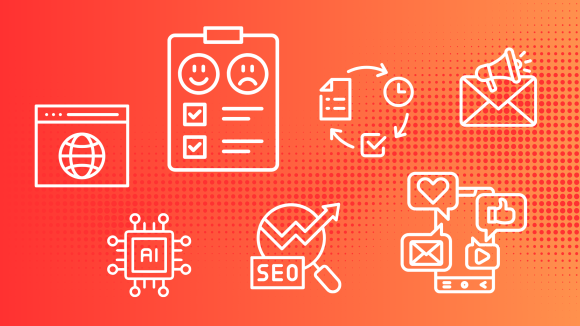
The top 11 essential digital tools for small businesses include website builder, digital advertising, SEO, email marketing, account tools, and survey software.
Why does it matter? With between 70 and 80% of small businesses having an online presence in the developed world, you can’t afford to be left behind.
Here’s a guide to the 11 essential tools you’ll need to get your small business thriving in the digital space.
1. Web Presence
A website is the foundation of your online presence.
Website builders allow you to create a professional website without needing advanced technical skills.
For small businesses, a website builds credibility, showcases your products or services, and gives customers a place to learn more about you.
Whether you’re a local service provider or selling products online, your website should make clear what your business stands for and what sets you apart from the competition.
It also helps to humanise your business with staff profiles and pictures of your physical locations.
Once your website is built, you need to make sure people can find your website.
You should add your business to listings on search engines and map features, letting people identify you and where you’re based.
Managing your profile on review websites and replying to reviews – whether positive, neutral, or negative – helps to build trust with existing customers and potential customers at the research stage.
Popular website builders include Squarespace, Wix, and Shopify.
Review websites to take control of your profile on include TrustPilot, Google reviews, G2 and Capterra.
And popular tools to manage your business listings on search engines and maps include Google Business Profile, Bing Places for Business and Apple Business Connect.
2. Email Marketing
Email marketing remains one of the most cost-effective ways to connect with your audience.
It allows you to communicate directly with customers who have already shown interest in your business.
With email campaigns, you can promote offers, share updates, and nurture relationships over time.
Unlike social media, where algorithms dictate how wide your content is pushed, email gives you direct access to your audience – making it a powerful tool for driving repeat business and customer loyalty.
Tools for email marketing include MailChimp, Brevo, and EmailBlaster.
3. Image Creation Tools
Visual content plays a huge role in how your business is perceived.
Tools like Canva make it easy to create professional graphics, even if you don’t have a designer with a strong creative background.
From social media posts to flyers and presentations, strong visuals help your business stand out and communicate your message more effectively.
For small businesses, this means you can maintain a polished brand image without hiring a designer for every task.
4. SEO Tools
Search Engine Optimization (SEO) tools help improve your website’s visibility on search engines like Google.
For small businesses, being discoverable online is crucial.
SEO tools help you understand what your customers are searching for and optimize your website accordingly, putting these products or services front and centre.
The higher you rank in search results, the more likely potential customers are to find your business and choose you over your competitors.
Tools such as Ahrefs, Moz, and SEMrush can help you develop your SEO strategies.
5. Social Media
Social media platforms give small businesses a chance to connect with their audience in a more personal and interactive way.
Whether it’s sharing updates, responding to comments, or showcasing behind-the-scenes content, social media helps humanise your brand.
It’s also a powerful way to build community, increase brand awareness, and drive traffic to your website.
Authentic engagement can turn followers into loyal customers that keep coming back – and impress potential new customers who find their way onto your page.
Short-form videos work well on TikTok and Instagram, while carousels, video, image and text-based content is suited to LinkedIn and Facebook.
Humanising content works best – let customers see the faces and personalities behind the company.
6. Paid Advertising
While SEO is a long-term strategy, paid advertising tools like Google Ads provide immediate visibility.
Google Ads or Amazon ads allows small businesses to appear at the top of search results for specific keywords.
This means you can reach potential customers right when they’re actively searching for what you offer.
Social media advertising also increases the reach of your adverts, posts, and profile.
With the right strategy, it can deliver highly targeted traffic and a strong return on investment.
7. Survey Software
Globally, 96% of customers view customer service as critical to brand loyalty.
This means the ability to understand customer sentiment is essential, as is the ability to right a wrong.
Running regular customer and employee surveys helps you understand what is working, what isn’t working, and measure the effectiveness of changes.
Feedback also helps you identify new opportunities – such as product offerings you may not have considered otherwise.
And to run surveys, you need to the right survey platform to help you design engaging surveys, distribute them, analyse the data and generate reports that highlight the key stories in your data.
Be sure to consider a platform’s security credentials, as protecting customer data is a legal requirement.
Popular platforms include Snap Surveys, Qualtrics, and SurveyMonkey. Snap Surveys offers managed surveys with every plan, meaning you don’t have to set up the survey or create reports yourself.
8. Accounting & Payroll Tools
Making money is the goal of every business – but managing your revenue can be challenging.
Accounting and payroll tools help simplify this process by keeping your financial records organised, accurate, and compliant.
Tools like QuickBooks and Xero allow small business owners to track income and expenses, manage invoices, and monitor cash flow without the stress of manual spreadsheets.
Having a clear financial overview helps you make better decisions, avoid surprises, and plan for growth.
Payroll tools are also useful for ensuring your employees are paid correctly and on time.
This reduces the risk of costly errors and saves valuable time that can be better spent on running your business.
Finally, every business needs to make money. Offering credit card payment options (SumUp, Square, Stripe, WorldPay) ensures customers face minimal barriers to paying for your products and services.
9. Customer Relationship Management (CRM) Tools
CRM tools help small businesses organise and manage all customer data in one central location.
From contact details and purchase history to email conversations and sales pipelines, this data is easily accessible.
The major benefit to small businesses is this information allows you to provide a more personalised experience, respond to communication faster, and never miss an important follow-up.
CRM tools also provide efficiency to sales and marketing.
You can automate emails, track leads, and set reminders for follow-up communications – helping you better understand your customers’ habits and ensure your business is more responsive.
Popular CRM tools for small businesses include HubSpot CRM, Salesforce, and Pipedrive.
10. Project Management Tools
Project Management tools help small businesses to keep on top of their workflows and ensure nothing slips through the net.
They improve organisation and efficiency, leading to better business performance across multiple metrics.
These include:
- Organisation and Time management
- Onboarding and integration
- Employee engagement
- Keeping stakeholders in the loop
- Ensures accountability
- Boosts productivity and collaboration
Popular project management tools include Trello, Monday, and ClickUp.
11. AI Tools
Small businesses may be limited on time and resources, which makes AI tools a great option for improving efficiency.
AI tools can help by automating repetitive tasks like customer responses, scheduling, and basic admin work. This gives you more time to focus on growth and strategy. These tools can also improve customer experience through faster, more consistent communication.
AI tools can also support marketing by helping create content, analyse performance, and identify what resonates with your audience.
Ultimately, AI tools give small businesses the ability to scale more effectively without increasing costs, helping you stay competitive.
Popular AI tools include ChatGPT, Claude, Gemini.
How can small businesses research digital tools?
The key for small businesses researching digital tools is to start with the basics, stay consistent, and build from there.
Here’s the digital tool selection process:
- Identify the pain point
- What must the tool include? and what are nice-to-haves?
- What is your budget?
- Research for a long list
- What do similar organisations use
- What do review sites recommend
- Conduct a Google search
- Search on AI platforms
- Look at what people say on forums like Reddit
- Feature match against the items you listed in point 2
- Scalability
- Ease of use
- Trial products
- Security review
- Short list
- Recycle steps and decide
This requires careful consideration and planning, understanding your business and how best you can reach potential customers.
Conclusion
Digital tools aren’t merely a luxury, they’re essential for growth in today’s competitive landscape.
By investing in the right mix of marketing, design, and advertising tools, small businesses can operate more efficiently and reach more customers. And once you’ve grown your audience, you can boost retention by inviting their feedback and acting on it.
The key is to start with the basics, stay consistent, and build from there.